Finding the right product to sell on Amazon can be one of the most challenging parts of starting an FBA business.
A product might look profitable at first glance, but high competition, unpredictable demand, expensive shipping, or hidden Amazon fees can quickly turn an attractive opportunity into a costly mistake.
That’s why choosing the best Amazon FBA product research tools is an important step for both beginners and experienced sellers.
These tools help sellers evaluate customer demand, analyze competitors, estimate potential sales, identify relevant keywords, and calculate profitability before investing in inventory.
However, not every research tool is designed for the same type of Amazon business.
Some are ideal for private-label sellers, while others work better for online arbitrage, wholesale sourcing, or tracking historical prices.
In this guide, we’ll compare seven useful Amazon product research tools, explain their strengths and limitations, and show you how to choose the right solution for your business.
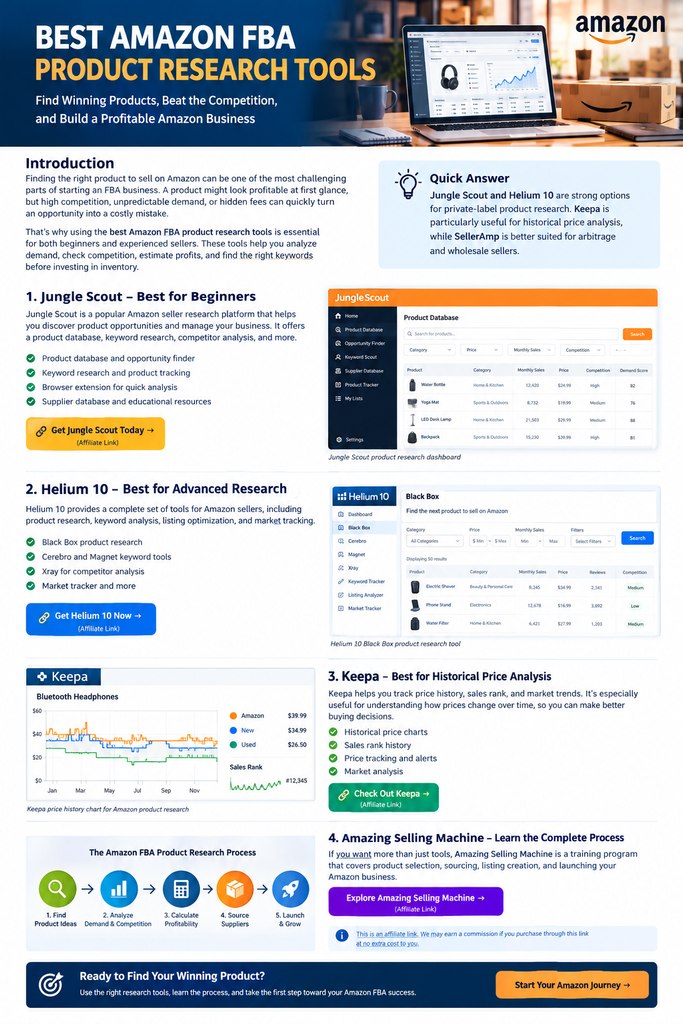
Quick Answer: Jungle Scout and Helium 10 are strong options for private-label product research. Keepa is particularly useful for historical price analysis, while SellerAmp is better suited to sourcing and profitability checks for arbitrage and wholesale sellers.
What Are Amazon FBA Product Research Tools?
Amazon FBA product research tools are software applications that help sellers identify and evaluate products they might sell through Amazon’s Fulfillment by Amazon program.
Rather than selecting products based entirely on intuition, sellers can use research software to investigate important factors such as:
- Estimated monthly product sales
- Customer demand and search activity
- Competition and review counts
- Historical selling prices
- Product size and shipping costs
- Potential profit margins
- Seasonal demand patterns
- Relevant Amazon search keywords
These insights can reduce uncertainty, although they cannot guarantee that a product will sell successfully.
For example, a product research tool might suggest that a particular kitchen accessory generates significant monthly revenue.
That information alone doesn’t make it a good investment.
You must also investigate how many established competitors sell similar products, whether demand is seasonal, and whether enough profit remains after expenses.
The most useful product research process combines software estimates with independent market validation.
Best Amazon FBA Product Research Tools: Quick Comparison
| Tool | Best For | Main Strength | Potential Drawback |
|---|---|---|---|
| Jungle Scout | Beginners and private-label sellers | Product discovery and market research | Subscription expense |
| Helium 10 | Growing Amazon businesses | Extensive research and keyword tools | Learning curve |
| AMZScout | Product idea validation | Product discovery and analysis | Feature access varies by plan |
| Keepa | Historical market analysis | Price and sales-rank history | Limited product discovery |
| SellerAmp SAS | Arbitrage and wholesale | Sourcing and profitability checks | Less focused on private-label discovery |
| ZonGuru | Private-label sellers | Research and listing optimization | May be unnecessary for occasional research |
| Amazon Seller Central | Budget-conscious beginners | Official seller tools and calculators | Less comprehensive discovery functionality |
The best choice depends on your selling model, available budget, and experience.
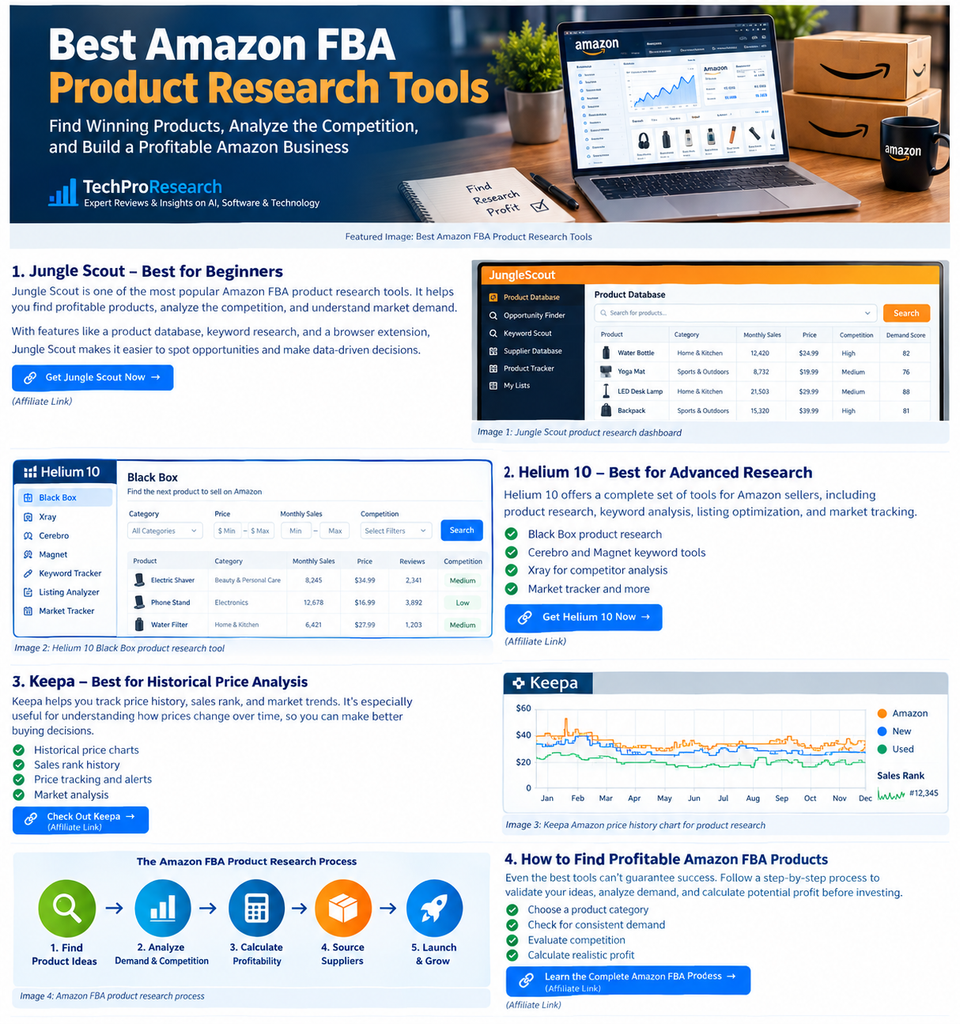
1. Jungle Scout — Best for Beginners
Jungle Scout is a well-known Amazon seller research platform designed to help entrepreneurs discover product opportunities and manage their businesses.
Its research capabilities include a product database, opportunity discovery, keyword analysis, product tracking, and a browser extension. Jungle Scout
Key Features
Product Database
Search for products using criteria such as categories, estimated sales, prices, and competition indicators.
Opportunity Finder
Explore potential market opportunities and investigate niches that may have room for new sellers.
Product Tracker
Monitor selected products over time instead of making decisions based on a single day’s performance.
Keyword Scout
Research relevant search terms that customers use when shopping on Amazon.
Supplier Database
Explore supplier information to support the product sourcing process.
Pros
- Useful product discovery features
- Combines research and business management tools
- Browser extension for faster product evaluation
- Helpful for private-label research
- Includes educational resources
Cons
- Paid plans may be expensive for new sellers
- Sales estimates are not guaranteed results
- Requires time to understand research metrics
Who Should Use Jungle Scout?
Jungle Scout is a strong option for entrepreneurs planning to launch their first private-label product.
It is particularly useful when you need a structured way to move from a broad product idea to a shortlist of potential opportunities.
Verdict: A good starting point for beginners who want product research and business tools in one platform.
[IMAGE 1 — Jungle Scout product research dashboard]
Suggested ALT text: Jungle Scout Amazon FBA product research dashboard for finding profitable products.
2. Helium 10 — Best for Advanced Amazon Research
Helium 10 provides a broad collection of tools for Amazon sellers.
Its product research tools include Black Box and Xray, while Cerebro and Magnet support keyword research.
The platform also provides listing optimization, market tracking, and business analytics functionality. Helium 10
Key Features
Black Box
Filter a large product database to identify opportunities based on criteria such as sales estimates, prices, reviews, and competition.
Xray
Analyze product information directly while browsing Amazon.
Cerebro
Investigate keywords associated with competing products.
Magnet
Discover additional keywords related to a product or niche.
Market Tracker
Monitor market conditions and competitors over time.
Pros
- Extensive research capabilities
- Combines product and keyword research
- Useful competitor analysis
- Supports different stages of business growth
- Includes tools beyond product discovery
Cons
- Can feel complicated for beginners
- Advanced functionality requires a subscription
- Research estimates still need verification
Who Should Use Helium 10?
Helium 10 is particularly suitable for sellers who want to combine product research, keyword research, listing optimization, and performance monitoring.
Verdict: One of the strongest all-in-one options for sellers who expect to expand their Amazon business.
[IMAGE 2 — Helium 10 Black Box product research interface]
Suggested ALT text: Helium 10 Black Box Amazon FBA product research tool showing product opportunity filters.
Want to Learn How to Apply Product Research?
Research software provides data, but beginners may also need help understanding how to turn that information into a complete Amazon business.
Amazing Selling Machine is an Amazon FBA training program covering product selection, sourcing, listing creation, and launching an Amazon business.
It is a training program rather than a direct replacement for Jungle Scout or Helium 10.
➡️ Explore Amazing Selling Machine Amazon FBA Training
purchasing through this link may earn us a commission.
3. AMZScout — Best for Finding Product Ideas
AMZScout offers tools designed to help sellers research Amazon products, investigate niches, and evaluate potential opportunities.
It can be useful for sellers who want to explore product ideas before committing money to inventory.
Key Features
Product Research
Investigate potential products using available market data and filtering options.
Browser Extension
Review product information while browsing Amazon.
Competition Analysis
Evaluate competing listings to understand how difficult entering a niche might be.
Product Validation
Compare potential opportunities using estimated demand and competition indicators.
Pros
- Focuses on Amazon product research
- Useful for investigating niche opportunities
- Offers browser-based analysis
- Can support early-stage product selection
Cons
- Available features depend on the selected plan
- Estimated sales require independent verification
- Not every promising niche will be profitable
Who Should Use AMZScout?
AMZScout may appeal to beginners who want a dedicated research solution without immediately investing in a broader business management platform.
Verdict: Worth comparing with Jungle Scout and Helium 10 when your main priority is product discovery.
4. Keepa — Best for Amazon Price History
Keepa is particularly valuable for understanding how Amazon product prices and sales ranks have changed over time.
This historical perspective can reveal information that current product prices alone cannot provide.
For example, a product selling for $35 today might have regularly sold for $22 during the previous six months.
Without historical data, a seller could overestimate the product’s long-term profitability.
Key Features
Historical Price Charts
Review previous prices and identify fluctuations.
Sales Rank History
Examine historical ranking patterns as one indicator of product demand.
Price Tracking
Monitor selected products and changes in their selling prices.
Market Analysis
Use historical information to investigate seasonality and competitive changes.
Pros
- Useful historical information
- Helps identify price volatility
- Valuable for arbitrage and wholesale research
- Can complement other research tools
Cons
- Not a complete private-label research platform
- Historical sales rank is not an exact sales count
- Some advanced data requires paid access
Who Should Use Keepa?
Keepa is especially useful for sellers who want to understand price behavior before purchasing inventory.
Verdict: A valuable supporting research tool, particularly when historical pricing matters.
[IMAGE 3 — Amazon product price history chart]
Suggested ALT text: Amazon product price history analysis using Keepa for FBA product research.
5. SellerAmp SAS — Best for Online Arbitrage
SellerAmp SAS focuses on helping Amazon sellers evaluate sourcing opportunities.
Unlike tools primarily designed for discovering new private-label products, SellerAmp is particularly useful for retail arbitrage, online arbitrage, and wholesale.
Its features include profitability calculations, eligibility information, sales-rank analysis, and product alerts. Seller Amp – Tools For Amazon Sellers
Key Features
Profitability Calculator
Estimate potential profits after accounting for relevant costs and fees.
Eligibility Checks
Investigate whether an item may have selling restrictions.
Product Alerts
Identify potential concerns, including certain intellectual property and product restrictions.
Sales Analysis
Review information that helps assess demand and competition.
Browser Extension
Analyze potential products while browsing online stores.
Pros
- Particularly useful for sourcing
- Profit and ROI calculations
- Supports arbitrage and wholesale workflows
- Helps identify potential product risks
Cons
- Less suitable as a primary private-label discovery platform
- Requires accurate cost information
- Subscription costs must be considered
Who Should Use SellerAmp?
SellerAmp is a strong choice for sellers buying existing products to resell on Amazon.
Verdict: Better suited to arbitrage and wholesale sourcing than launching a completely new private-label brand.
6. ZonGuru — Best for Private-Label Research and Optimization
ZonGuru provides software designed to support Amazon sellers with product research, keyword analysis, listing optimization, and business management.
It may appeal to entrepreneurs who want research capabilities alongside tools for improving product listings.
Key Features
Niche Research
Explore potential product categories and evaluate market opportunities.
Keyword Research
Investigate search terms relevant to potential products.
Listing Optimization
Improve product page content using research insights.
Business Monitoring
Track selected aspects of an Amazon selling operation.
Pros
- Useful for private-label sellers
- Combines research and optimization
- Supports product and keyword analysis
- Can reduce the need for separate tools
Cons
- Paid subscription
- Some features may be unnecessary for beginners
- Requires learning the platform
Who Should Use ZonGuru?
ZonGuru is worth considering if you want software that supports both researching a product and optimizing its listing after launch.
Verdict: An alternative to larger all-in-one Amazon seller platforms.
7. Amazon Seller Central — Best Free Starting Point
Amazon Seller Central is the official platform used by third-party Amazon sellers.
Although it is not a direct substitute for dedicated product discovery software, it provides valuable tools and information for evaluating a selling opportunity.
Useful Resources
Amazon Revenue Calculator
Estimate fulfillment costs and compare different fulfillment methods.
Seller Central Reports
Eligible sellers can access business reports and other performance information.
Product Restrictions
Investigate whether certain products or categories require approval.
Amazon Search Results
Manually examine competing products, reviews, prices, and customer feedback.
Pros
- Official Amazon resources
- Useful fee calculations
- Helps validate product costs
- Some research can be performed without paid third-party software
Cons
- Limited product discovery compared with specialist tools
- Certain reports require an active seller account or eligibility
- Manual research can be time-consuming
Who Should Use Amazon Seller Central?
Every prospective Amazon seller should understand the official platform and its available resources.
Verdict: A useful starting point for beginners who want to investigate opportunities before purchasing additional software.
How to Choose the Best Amazon FBA Product Research Tool
Choosing the right tool requires more than comparing feature lists.
Your business model should determine which research capabilities matter most.
1. Identify Your Amazon Selling Model
Private-label sellers generally need product discovery, demand analysis, keyword research, and competitor insights.
Online arbitrage sellers need reliable sourcing analysis, historical prices, selling eligibility information, and profitability calculations.
Wholesale sellers may prioritize price history, competing offers, and consistent product demand.
2. Set a Research Budget
A research subscription is a business expense.
Before subscribing, calculate how much you can reasonably spend while preserving enough money for inventory, shipping, advertising, and unexpected expenses.
Paying for several overlapping research platforms may be unnecessary.
3. Evaluate Data Quality
Sales estimates are useful, but they are not guaranteed figures.
Compare multiple signals before making a decision.
These may include historical prices, review activity, competition, customer demand, and realistic profit calculations.
4. Consider Ease of Use
A powerful research tool is not necessarily the best choice if you cannot use its features effectively.
Beginners may benefit from a simpler research workflow before adopting advanced analytics.
5. Look Beyond Product Discovery
Finding a potential product is only the beginning.
You must also understand sourcing, fulfillment fees, inventory management, product compliance, and launching your listing.
Learn the Complete Amazon FBA Process
If you’re new to selling on Amazon and want structured guidance beyond research software, Amazing Selling Machine offers training covering multiple stages of building an Amazon FBA business.
➡️ Discover the Amazing Selling Machine Training Program
review the current course details and pricing before purchasing.
How to Find Profitable Amazon FBA Products: Step-by-Step
Even the best software cannot eliminate the risks of selling on Amazon.
However, following a consistent research process can help you make more informed decisions.
Step 1: Identify a Product Category
Start with a category you understand or are willing to research thoroughly.
For example:
- Home organization
- Kitchen accessories
- Office supplies
- Pet accessories
- Travel accessories
Avoid choosing a category solely because a research tool displays attractive revenue estimates.
Step 2: Look for Consistent Demand
Use a product research tool to investigate estimated sales and search demand.
Then examine historical data.
A product with steady demand throughout the year may be easier to plan inventory for than a highly seasonal product.
Seasonal products are not necessarily bad investments, but they require different purchasing and inventory strategies.
Step 3: Evaluate Competition
Investigate the leading competing products.
Pay attention to:
- Number and quality of reviews
- Brand recognition
- Product differentiation
- Listing quality
- Selling prices
- Advertising competition
A market with substantial demand may still be difficult to enter if established brands dominate the results.
Step 4: Calculate Realistic Profit
Let’s consider a hypothetical product:
| Expense | Amount |
|---|---|
| Selling price | $29.99 |
| Product manufacturing | $6.00 |
| Shipping and preparation | $2.50 |
| Estimated Amazon fees | $9.00 |
| Estimated advertising cost per sale | $4.00 |
| Estimated profit | $8.49 |
In this simplified example, the estimated profit margin is approximately 28.3%.
However, the calculation excludes some potential expenses, including returns, storage charges, software subscriptions, taxes, and overhead.
The actual profit could therefore be lower.
Always confirm current fulfillment fees using Amazon’s official calculator.
Step 5: Read Customer Reviews
Customer reviews can reveal opportunities for product improvements.
Look for recurring complaints rather than isolated negative comments.
For example, customers might consistently mention that a storage organizer is difficult to assemble.
A better-designed alternative could potentially address that problem.
However, improvements must be practical and financially viable.
Step 6: Investigate Suppliers
Before placing a large inventory order, compare potential suppliers.
Consider manufacturing quality, minimum order quantities, lead times, shipping arrangements, and product compliance requirements.
Where appropriate, request samples and conduct quality checks.
Step 7: Validate Before Investing
Research should narrow down uncertainty, not create false confidence.
Before committing to inventory, confirm that your product meets applicable requirements and that your expected margins can withstand changes in costs or selling prices.
[IMAGE 4 — Amazon FBA product research workflow]
Suggested ALT text: Step-by-step Amazon FBA product research process from market analysis to profitability validation.
Common Amazon Product Research Mistakes
Choosing Products Based Only on Revenue
High revenue does not automatically mean high profit.
A product generating substantial sales may also have expensive advertising, shipping, and manufacturing costs.
Ignoring Competition
Strong demand attracts competitors.
Investigate whether your product offers a meaningful reason for customers to choose it over existing alternatives.
Overlooking Seasonal Demand
A product that performs exceptionally well during a holiday season might sell much more slowly during the rest of the year.
Historical data helps reveal these patterns.
Trusting Estimates Too Much
Research tools rely on models, available data, and assumptions.
Different platforms may produce different sales estimates for the same product.
Treat those figures as decision-support information rather than guaranteed results.
Buying Inventory Too Early
Avoid placing large orders before validating product quality, compliance, sourcing costs, and realistic profit margins.
Are Amazon FBA Product Research Tools Worth the Money?
For many sellers, product research tools can save time and improve the quality of market analysis.
However, the value depends on how frequently you use the software and whether its features support your selling strategy.
A beginner investigating a handful of ideas may not need an expensive monthly subscription immediately.
An established seller launching multiple products may benefit significantly from advanced research, tracking, and automation capabilities.
The best investment is not necessarily the most expensive tool. It’s the tool that helps you make better decisions at a sustainable cost.
It’s also important to recognize that software alone doesn’t teach every part of running an Amazon business.
Product selection, supplier negotiations, compliance, inventory management, and marketing all require additional knowledge.
Need More Than Research Software?
Amazing Selling Machine is designed for people who want structured Amazon FBA training, including guidance on product selection and launching a business.
It may be worth evaluating if you prefer a guided learning program rather than relying exclusively on software and free educational materials.
➡️ Learn More About Amazing Selling Machine
course enrollment involves a separate purchase. Results are not guaranteed.
Frequently Asked Questions
What is the best Amazon FBA product research tool for beginners?
Jungle Scout is a strong option for beginners because it combines product discovery, competitor research, keyword analysis, and educational resources.
Helium 10 is another option, particularly for sellers who want more extensive functionality.
Can I research Amazon FBA products for free?
Yes.
You can begin by examining Amazon search results, comparing competing listings, reading customer reviews, and using available official Amazon resources.
However, free research methods may require more manual work and provide less comprehensive data than paid tools.
Is Helium 10 better than Jungle Scout?
Neither platform is automatically better for every seller.
Helium 10 offers a broad range of tools, while Jungle Scout provides a structured environment for product discovery and seller research.
The best choice depends on your experience, budget, and required features.
How do I find low-competition Amazon products?
Start by identifying products with consistent demand.
Then investigate competing listings, review counts, brand strength, search relevance, and opportunities for differentiation.
Low competition alone does not guarantee profitability.
How much money do I need to start Amazon FBA?
Startup costs vary significantly depending on the product, business model, inventory quantity, shipping arrangements, and advertising strategy.
Calculate your expected costs before investing rather than relying on a universal startup budget.
Can Amazon product research tools guarantee profitable products?
No.
Research software provides estimates and insights that can support decision-making.
Profitability ultimately depends on factors such as demand, competition, product quality, costs, marketing, and execution.
Do I need an Amazon FBA course to start selling?
No. You can learn through free resources, official Amazon education, and independent research.
However, some beginners prefer structured training that explains the process in a specific sequence.
Before purchasing a course, compare its curriculum, current price, support options, and refund conditions.
Final Verdict: Which Amazon FBA Research Tool Should You Choose?
The best Amazon FBA product research tools can help sellers identify opportunities, evaluate competition, and make more informed inventory decisions.
For beginners interested in private-label selling, Jungle Scout is a practical starting point.
Helium 10 is worth considering for sellers who want extensive research and business management capabilities.
Keepa is particularly valuable for understanding historical price patterns, while SellerAmp is better suited to arbitrage and wholesale sourcing.
If your budget is limited, begin with manual research and available Amazon resources before committing to paid software.
Remember that finding a promising product is only one part of building a successful Amazon business.
You also need to understand sourcing, profitability, product compliance, and how to launch and manage your listings.
For readers who prefer structured instruction, Amazing Selling Machine is an additional training option worth researching.
➡️ Explore Amazing Selling Machine and Its Amazon FBA Training
check the current offer, price, and terms before enrolling.
The bottom line: Choose research tools based on your selling model, verify their findings independently, and never invest in inventory solely because a software platform predicts attractive sales.
Final Thoughts: Start Your Amazon FBA Product Research the Smart Way
Choosing the right Amazon FBA product research tool depends on your business model, experience, and budget. Jungle Scout and Helium 10 are useful options for private-label sellers, while Keepa helps analyze historical prices and SellerAmp supports online arbitrage research.
If you are a beginner, start with free research methods and Amazon’s official resources before committing to expensive subscriptions. Compare product demand, competition, sourcing costs, and potential profit margins before investing in inventory.
Remember, successful Amazon FBA selling starts with informed decisions, not expensive software. Take your time, validate your product ideas, and choose tools that support your long-term business goals.