Starting an Amazon business can be exciting, but choosing the right training program is often one of the first major challenges.
With hundreds of Amazon FBA courses available online, beginners frequently struggle to identify which programs provide practical instruction, which offer genuine value, and which are simply overpriced.
If you’re searching for the best Amazon seller course in 2026, you’re probably looking for training that explains how to select profitable products, find reliable suppliers, create optimized listings, and build a sustainable Amazon business.
The good news is that you don’t necessarily need to spend thousands of dollars to learn how Amazon selling works.
Some excellent educational resources are completely free, while premium training programs offer additional benefits such as mentorship, structured lessons, business communities, and advanced selling strategies.
In this guide, we’ll explore seven Amazon seller training options, compare their strengths and limitations, and help you determine which approach best fits your experience, goals, and budget.
Quick Answer: Amazon Seller University is our recommended free starting point because it provides official training directly from Amazon. For entrepreneurs seeking a more structured private-label business program, Amazing Selling Machine is a premium alternative worth evaluating.
What Is an Amazon Seller Course?
An Amazon seller course is an educational program designed to teach individuals how to establish, operate, and grow a business selling products through Amazon’s marketplace.
Depending on the program, training may cover everything from opening a seller account to advanced advertising, inventory management, and brand development.
A comprehensive Amazon selling course should explain several essential areas:
- Amazon seller account setup and verification.
- Product research and market demand analysis.
- Competitor research and product differentiation.
- Finding and evaluating suppliers.
- Amazon FBA and FBM fulfillment methods.
- Product listing optimization and keyword research.
- Amazon advertising and launch strategies.
- Inventory planning and profitability calculations.
- Customer service and account health management.
However, not every course provides the same level of detail.
Some focus exclusively on beginners, while others teach advanced strategies designed for established sellers.
Choosing the right training depends on your preferred business model and how much money you’re prepared to invest.

7 Best Amazon Seller Courses in 2026
Below are seven training options and learning pathways worth considering.
1. Amazon Seller University — Best Free Amazon Seller Course
Best For: Beginners who want official Amazon training without paying for a course.
Amazon Seller University is an educational platform created by Amazon to help sellers understand marketplace operations.
It provides training covering product listings, fulfillment, pricing, advertising, and account management.
In July 2026, Amazon announced that its Seller University educational library had become accessible without requiring a seller account or login. Sell on Amazon
This makes it one of the most accessible starting points for aspiring Amazon entrepreneurs.
What You’ll Learn
Amazon Seller University covers essential topics such as:
- Creating and managing Amazon product listings.
- Understanding fulfillment options.
- Using Amazon Seller Central.
- Setting competitive product prices.
- Managing inventory and orders.
- Understanding Amazon advertising.
- Maintaining account health.
- Exploring brand-building tools.
The official platform provides educational videos and downloadable guides across more than 125 topics. Sell on Amazon
Advantages
One major advantage is that the educational material comes directly from Amazon.
This makes Seller University particularly valuable for learning official processes, marketplace policies, and platform functionality.
Another advantage is accessibility.
You can begin learning without purchasing expensive software or committing to a premium training program.
Limitations
Seller University primarily focuses on understanding Amazon’s selling tools and processes.
Entrepreneurs looking for personalized mentorship, private-label coaching, or individual product evaluations may need additional support.
Our Verdict: Amazon Seller University is the best free starting point for beginners who want to understand Amazon selling before investing in premium education.
Explore the official Amazon Seller University training platform.
2. Amazing Selling Machine — Best for Structured Private-Label Training
Best For: Entrepreneurs interested in building an Amazon FBA private-label business.
Amazing Selling Machine, commonly known as ASM, is a premium Amazon FBA training program focused on helping entrepreneurs develop and sell their own branded products.
Unlike general introductory courses, ASM emphasizes building a private-label business through product research, sourcing, branding, launching, and scaling.
Its official course materials describe a structured training program that includes video lessons, educational resources, and access to a seller community.
What Does Amazing Selling Machine Teach?
The training focuses on several stages of building an Amazon business.
Product Research
Students learn approaches to identifying potential product opportunities, evaluating demand, and analyzing competitors.
Supplier Selection
The program covers finding manufacturers, evaluating product quality, and developing relationships with suppliers.
Product Launching
Students explore product listing optimization, marketing strategies, and methods for introducing new products to the marketplace.
Business Growth
Advanced lessons address inventory management, advertising, customer relationships, and expansion strategies.
Advantages
ASM provides a structured learning path rather than requiring students to assemble information from unrelated tutorials.
Its private-label focus may appeal to entrepreneurs who want to develop a long-term brand instead of relying exclusively on product reselling.
The program also advertises access to educational resources and a private community.
Limitations
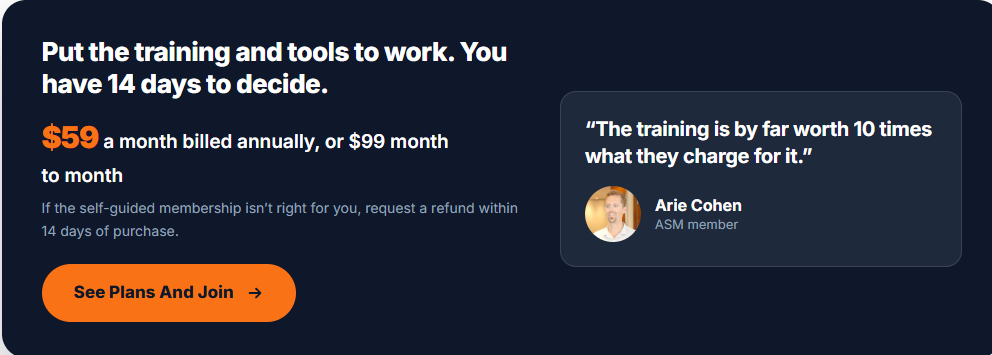
The biggest consideration is cost.
ASM is a premium program, and its training fees may represent a substantial investment for beginners.
The course fee is also separate from the capital required for inventory, product samples, shipping, advertising, and other business expenses.
Before enrolling, confirm the current price, curriculum, refund conditions, and support arrangements.
Our Verdict: Amazing Selling Machine is worth considering for entrepreneurs who want structured private-label training and have sufficient capital for both education and business operations.
After the Amazing Selling Machine review
3. Amazon FBA Beginner Training — Best for First-Time Sellers
Best For: People who have never sold a product on Amazon.
For complete beginners, a focused Amazon FBA training pathway may be more practical than an advanced business-building program.
Amazon FBA stands for Fulfillment by Amazon.
Under this fulfillment model, sellers send eligible inventory to Amazon’s fulfillment network, where Amazon handles storage, order picking, packing, shipping, and certain customer service functions.
However, sellers remain responsible for critical business decisions, including product selection, profitability, inventory planning, and compliance.
What Should Beginner Training Include?
A useful beginner program should teach you how to:
- Understand the Amazon marketplace.
- Choose an appropriate selling model.
- Research products with realistic demand.
- Calculate product costs and Amazon fees.
- Find potential suppliers.
- Prepare compliant product listings.
- Understand FBA inventory requirements.
- Plan a controlled product launch.
A beginner course should also explain the difference between revenue and profit.
For example, selling a product for $30 does not mean you earn $30.
You must subtract product costs, fulfillment fees, referral fees, advertising expenses, returns, and other operating costs.
Our Verdict: Beginners should prioritize practical fundamentals and profitability calculations before investing in advanced advertising or expensive mentorship.
For a detailed introduction, read our Amazon FBA for Beginners: Step-by-Step Guide (2026).
Amazing Selling Machine Amazon FBA Course
4. Amazon Product Research Training — Best for Finding Product Opportunities
Best For: Sellers who want to improve their product selection decisions.
Product research is one of the most important skills in Amazon selling.
A product may receive substantial search traffic but still be difficult to sell profitably because of intense competition, high advertising costs, or expensive fulfillment.
This is why specialized product research training can be valuable.
Essential Product Research Skills
A strong course should explain how to evaluate:
Market Demand
Look for evidence that customers consistently search for and purchase products within a particular category.
Competition
Evaluate competing listings, customer reviews, pricing, product differentiation, and established brands.
Profit Margins
Calculate realistic costs rather than relying on estimated revenue.
Product Differentiation
Identify opportunities to improve existing products through design, packaging, features, or customer experience.
Seasonality
Determine whether demand remains consistent throughout the year or depends heavily on seasonal trends.
Example: Evaluating Two Products
Imagine you’re comparing two potential products.
Product A has strong demand but dozens of established competitors.
Product B has moderate demand, fewer established competitors, and several opportunities for meaningful improvement.
Product B might offer a more attractive opportunity, even if its estimated sales volume is lower.
However, neither product should be selected without verifying costs, competition, and potential profitability.
Recommended Learning Approach
Combine product research education with practical exercises.
Choose several potential products, analyze their competition, estimate costs, and document why each opportunity might succeed or fail.
This helps develop decision-making skills rather than simply following a list of supposedly profitable products.
Our Verdict: Product research training is particularly valuable for sellers preparing to invest money in their first inventory order.
Read our Best Amazon FBA Product Research Tools in 2026: 7 Top Picks Compared for additional guidance.
Amazon Seller Keyword Research
5. Amazon Keyword Research Training — Best for Listing Optimization
Best For: Sellers who want to improve product visibility in Amazon search results.
Amazon keyword research is different from traditional Google SEO.
Customers searching on Amazon frequently have a direct purchasing intention.
For example, someone searching for “stainless steel insulated water bottle” may already be comparing products before making a purchase.
A well-designed Amazon keyword research course should teach sellers how to identify relevant search terms and use them naturally within product listings.
What You’ll Learn
Keyword Discovery
Identify the words and phrases customers use when searching for products similar to yours.
Search Intent
Understand the difference between broad category searches and highly specific purchase-oriented keywords.
Competitor Analysis
Study relevant competing listings to identify terminology, product features, and potential gaps.
Listing Optimization
Learn how to incorporate appropriate keywords into titles, bullet points, descriptions, and other eligible listing fields.
Performance Measurement
Evaluate listing visibility, conversion performance, and advertising data to determine whether your keyword strategy needs improvement.
Why Keyword Research Matters
A product listing cannot generate consistent organic sales if potential customers struggle to discover it.
However, adding more keywords does not automatically produce better rankings.
Product relevance, competitive pricing, customer experience, conversion performance, and other factors can influence marketplace results.
Keyword research should therefore support a broader product optimization strategy.
Our Verdict: Keyword research training is useful for both new sellers and established Amazon businesses looking to improve listing performance.
For a deeper explanation, explore our Amazon FBA Keyword Research for Experts: The Complete Guide to Finding Profitable Keywords.
6. Amazon PPC Advertising Training — Best for Growing Sellers
Best For: Sellers who already have products listed and want to understand paid advertising.
Amazon PPC, or pay-per-click advertising, allows eligible sellers to promote products through sponsored advertising placements.
Depending on the advertising format, sellers may pay when shoppers click an advertisement.
A specialized Amazon advertising course can help sellers understand how to structure campaigns, evaluate advertising performance, and control unnecessary spending.
Important Topics to Learn
Campaign Structure
Understand how advertising campaigns, ad groups, targeting methods, and budgets work together.
Keyword Targeting
Learn how to select relevant keywords and evaluate different targeting approaches.
Bid Management
Understand how advertising bids influence spending and placement opportunities.
Advertising Cost of Sales
ACoS measures advertising spending relative to sales attributed to advertising.
The formula is:
ACoS = (Advertising Spend ÷ Advertising Sales) × 100
For example:
- Advertising spend: $100
- Attributed advertising sales: $500
- ACoS: 20%
This means advertising costs represented 20% of attributed sales.
However, a 20% ACoS is not automatically profitable.
Actual profitability depends on product margins and other business expenses.
Why Advertising Training Can Be Valuable
Without a clear strategy, sellers may spend heavily on advertisements that generate clicks but few purchases.
Learning how to interpret advertising reports can help identify inefficient campaigns and improve budget allocation.
Our Verdict: PPC training becomes more valuable once a seller has an active product listing, reliable inventory, and sufficient margin to support advertising.
7. Amazon Business Scaling Training — Best for Experienced Sellers
Best For: Established sellers looking to expand their operations.
Once an Amazon business begins generating consistent sales, its challenges change.
Instead of focusing exclusively on launching products, business owners must manage inventory, cash flow, advertising budgets, supplier relationships, and operational efficiency.
Advanced Amazon seller courses often focus on these growth-related responsibilities.
Essential Scaling Skills
Inventory Forecasting
Estimate future inventory requirements to reduce the risk of stockouts and excess inventory.
Cash Flow Management
Understand how inventory purchases, advertising expenses, and marketplace payouts affect available working capital.
Supplier Negotiation
Learn how to evaluate supplier terms, quality standards, production timelines, and purchasing arrangements.
Product Expansion
Assess whether introducing additional products or variations makes financial sense.
Operational Systems
Develop repeatable processes for inventory monitoring, customer support, listing maintenance, and performance reporting.
When Should You Take an Advanced Course?
Advanced training generally makes more sense when you already understand the fundamentals and have specific operational problems to solve.
Purchasing expensive scaling education before launching your first product may not provide the best return on your investment.
Our Verdict: Advanced business training is most relevant for sellers with existing operations who need help solving measurable growth challenges.
Amazon FBA Training for Beginners
Best Amazon Seller Course Comparison: Free vs. Paid Training
| Course or Training Path | Best For | Cost Category | Main Focus |
|---|---|---|---|
| Amazon Seller University | Complete beginners | Free | Official Amazon selling fundamentals |
| Amazing Selling Machine | Private-label entrepreneurs | Premium paid | Building an Amazon FBA brand |
| Amazon FBA Beginner Training | First-time sellers | Free or paid | Starting an Amazon business |
| Product Research Training | Product-focused sellers | Free or paid | Evaluating product opportunities |
| Keyword Research Training | Listing optimization | Free or paid | Amazon SEO and search visibility |
| Amazon PPC Training | Active sellers | Free or paid | Advertising and campaign management |
| Business Scaling Training | Experienced sellers | Usually paid | Operations and business expansion |
Important: Several entries represent training categories rather than specific commercial courses. Pricing, instructor quality, curriculum, and support vary between providers.
How to Choose the Best Amazon Seller Course
Choosing the right Amazon seller course requires more than comparing prices.
A course should address your actual learning needs and help you develop practical skills.
Here are six factors worth evaluating before enrolling.
1. Your Experience Level
Beginners should prioritize account setup, product research, fulfillment, and basic profitability.
Experienced sellers may benefit more from advanced advertising, supplier management, or operational training.
Avoid paying for advanced material before understanding the fundamentals.
2. Your Business Model
Different Amazon business models require different skills.
For example:
Private Label: Focuses on developing and selling products under your own brand.
Wholesale: Involves purchasing products from authorized suppliers for resale.
Retail Arbitrage: Involves sourcing eligible products from retail stores and reselling them where permitted.
Online Arbitrage: Uses online retail sources to identify potential resale opportunities.
Each approach involves different operational challenges, costs, and compliance considerations.
Choose training that directly addresses your intended business model.
3. Course Curriculum
Review the full curriculum before purchasing.
Look for practical lessons covering product validation, profitability, supplier evaluation, fulfillment, and marketing.
A course promising financial success without discussing costs and risks should be approached cautiously.
4. Instructor Experience
Investigate whether the instructor demonstrates relevant, verifiable experience.
Useful evidence may include detailed educational examples, clear explanations of business challenges, and transparent information about their background.
Avoid assuming that impressive revenue screenshots prove profitability.
5. Student Support
Some students prefer self-paced video lessons.
Others benefit from live questions, structured feedback, or access to an educational community.
Determine whether additional support justifies the course price.
6. Total Investment
Course fees represent only one part of your potential expenses.
Depending on your business model, you may also need money for:
- Inventory purchases.
- Product samples.
- Shipping and preparation.
- Amazon selling and fulfillment fees.
- Product photography.
- Advertising.
- Software subscriptions.
- Returns and unexpected expenses.
A course should help you understand these costs before encouraging you to launch.
Are Expensive Amazon Seller Courses Worth It?
An expensive course is not necessarily better than an affordable alternative.
Premium training may offer valuable structure, mentorship, and community support.
However, the information itself is not always exclusive.
Amazon provides extensive official educational resources, and many essential concepts can be learned through free training.
The real question is whether a paid course provides enough additional value to justify its cost.
Consider two hypothetical beginners.
Beginner A has a limited budget and no previous ecommerce experience.
This person may benefit most from completing Amazon Seller University, studying product research, and building a realistic business budget.
Beginner B has previous business experience, sufficient startup capital, and a specific plan to launch a private-label brand.
This person may find structured premium education more useful.
Neither approach guarantees success.
The best choice depends on your financial circumstances, learning preferences, and business objectives.
How Much Money Do You Need to Start Selling on Amazon?
There is no universal startup budget for Amazon sellers.
The amount required depends on your marketplace, selling model, product category, inventory strategy, and marketing approach.
For example, a private-label business requiring custom manufacturing may need significantly more capital than a small-scale resale operation.
A realistic startup budget should account for the following expenses.
| Expense | What to Consider |
|---|---|
| Seller account | Subscription and selling fees |
| Product inventory | Initial stock requirements |
| Product samples | Supplier quality verification |
| Shipping | Transportation and preparation |
| Fulfillment | Applicable storage and fulfillment fees |
| Advertising | Product launch and ongoing promotion |
| Software | Optional research and management tools |
| Emergency reserve | Returns, delays, and unexpected costs |
Before ordering inventory, estimate the total cost per unit and compare it with a realistic selling price.
Example Profit Calculation
Imagine a hypothetical product with these figures:
| Item | Amount |
|---|---|
| Selling price | $30.00 |
| Product cost | $8.00 |
| Shipping and preparation | $2.00 |
| Referral fee | $4.50 |
| FBA fulfillment fee | $4.00 |
| Advertising cost per sale | $5.00 |
| Estimated contribution profit | $6.50 |
In this example, the estimated contribution margin is approximately 21.7%.
However, this calculation excludes additional expenses such as storage, returns, software, taxes, and fixed business costs.
The figures are illustrative, not actual Amazon fee quotes.
This is why understanding profitability is more important than focusing exclusively on potential sales revenue.
Can You Learn Amazon FBA Without Buying a Course?
Yes.
It is possible to learn the fundamentals of Amazon FBA without purchasing a premium training program.
Amazon Seller University provides official education covering marketplace operations and essential selling tools.
You can supplement this training with practical product research, competitor analysis, and carefully planned experiments.
A sensible free-learning pathway might look like this:
Week 1: Learn the Fundamentals
Understand Amazon Seller Central, selling models, account requirements, and fulfillment options.
Week 2: Study Product Research
Practice evaluating market demand, competition, pricing, and product differentiation.
Week 3: Understand Costs and Suppliers
Learn how to estimate profitability, compare supplier quotations, and identify operational risks.
Week 4: Study Listings and Advertising
Explore keyword research, listing optimization, advertising fundamentals, and performance measurement.
Four weeks will not make someone an expert.
However, this learning structure can provide a useful foundation before committing money to inventory or advanced training.
Common Mistakes When Choosing an Amazon Selling Course
Even motivated entrepreneurs can make costly decisions when selecting training.
One common mistake is purchasing a course based entirely on income claims.
Revenue examples may look impressive, but they rarely tell the full story about advertising expenses, inventory costs, returns, and business profitability.
Another mistake is choosing a course that teaches the wrong business model.
Someone interested in wholesale may gain limited value from a program focused exclusively on private-label product development.
A third mistake is ignoring marketplace changes.
Amazon regularly updates its policies, tools, and operational requirements.
Training should encourage students to verify important information against current official guidance.
Finally, some beginners spend too much of their available capital on education.
A premium course may be useful, but it cannot replace the money required to operate a real business.
Best Amazon Seller Course for Beginners: Our Recommendation
For most complete beginners, we recommend starting with Amazon Seller University.
It provides official educational content without requiring an expensive course purchase.
It also allows aspiring sellers to explore the fundamentals before deciding whether Amazon selling fits their interests and financial situation.
For entrepreneurs who already understand the basics and want to pursue private-label selling, Amazing Selling Machine offers a more structured premium training option.
However, its cost should be evaluated carefully against your available startup capital.
Our recommended learning strategy is straightforward:
Start with free education, identify your intended selling model, practice product research, and evaluate whether paid training would solve a specific problem.
This approach helps reduce unnecessary spending while building practical knowledge.
Frequently Asked Questions About Amazon Seller Courses
What is the best Amazon seller course in 2026?
Amazon Seller University is our recommended free course for beginners because it provides official educational resources covering essential marketplace operations.
For structured private-label training, Amazing Selling Machine is a premium alternative worth researching.
What is the best free Amazon seller course?
Amazon Seller University is one of the strongest free options available.
It provides training on product listings, fulfillment, pricing, advertising, and other essential Amazon selling topics.
Is Amazon FBA difficult for beginners?
Amazon FBA can be challenging because sellers must understand product research, competition, supplier management, profitability, inventory, and marketplace policies.
However, structured education and careful planning can make the learning process more manageable.
How long does it take to learn Amazon FBA?
Beginners can learn fundamental concepts within several weeks.
Developing practical experience and becoming proficient at product selection, advertising, and inventory management generally takes considerably longer.
The timeline varies depending on individual experience and available resources.
Are paid Amazon FBA courses worth the money?
Paid courses may be valuable when they offer structured instruction, relevant mentorship, and practical support.
However, beginners should compare paid programs with free resources before making a financial commitment.
Can I start selling on Amazon without experience?
Yes. Many sellers begin without previous ecommerce experience.
However, account eligibility, business registration requirements, product restrictions, and other obligations vary by marketplace and location.
Understanding these requirements is essential before launching.
Can an Amazon seller course guarantee profits?
No legitimate educational program can guarantee that your Amazon business will become profitable.
Results depend on product selection, costs, competition, execution, market conditions, and numerous other factors.
Should I learn Amazon FBA or Amazon wholesale?
Both approaches can be viable, but they require different skills.
FBA is a fulfillment service, while wholesale is a product sourcing and resale model. A wholesale seller may also use FBA.
Your decision should depend on your business objectives, supplier access, available capital, and risk tolerance.
Final Verdict: Which Amazon Seller Course Should You Choose?
Finding the best Amazon seller course in 2026 is ultimately about selecting education that matches your goals rather than choosing the most expensive program.
For beginners, Amazon Seller University provides an accessible introduction to selling on Amazon.
For aspiring private-label entrepreneurs, Amazing Selling Machine offers a structured premium alternative.
Specialized training in product research, keyword optimization, advertising, and business operations can become more valuable as your experience grows.
Before purchasing any course, review its curriculum, confirm current pricing, investigate instructor credibility, and calculate how much capital you will still need to operate your business.
The best Amazon seller course is the one that helps you make better business decisions—not the one that promises the biggest income.
Amazing Selling Machine Amazon FBA Course
Affiliate Disclosure: TechProResearch may earn a commission when readers purchase through qualifying affiliate links, at no additional cost to them. Our recommendations are based on educational relevance, available product information, and practical considerations. We do not guarantee business results.