Can CaseBound really help you write a complete mystery novel with AI, or is it just another writing tool making big promises?
If you’ve ever dreamed of publishing your own mystery novel but struggled with plotting, character development, or maintaining consistency across chapters, CaseBound might be worth exploring.
Created by author Kevin Berry, CaseBound is an AI-assisted mystery writing studio designed to help aspiring authors transform a simple story idea into a structured manuscript.
Unlike general-purpose AI writing tools, CaseBound focuses specifically on mystery fiction, helping writers develop suspects, motives, clues, timelines, and believable endings before drafting chapters.
But there’s an important question:
Is CaseBound worth buying in 2026, especially when tools like Claude can already generate fiction?
In this detailed CaseBound review, we’ll examine its features, pricing, advantages, limitations, published-book examples, and whether it offers enough value to justify its price.
We’ll also compare its three editions to help you decide which one makes the most sense.
Disclosure: This article contains affiliate links. We may earn a commission if you purchase through our links, at no additional cost to you. This review is based on publicly available product information and published examples, not independent hands-on testing.
CaseBound Review 2026: Quick Verdict
CaseBound appears to be a promising option for aspiring mystery authors who want more structure than a standard AI chatbot provides.
Its strongest selling point isn’t simply generating text.
It’s the structured process that connects the mystery’s solution, suspects, clues, character relationships, and chapter development.
Instead of immediately asking AI to write a novel, CaseBound encourages writers to establish the underlying logic of their mystery first.
That distinction could be particularly valuable for beginners who struggle to maintain a coherent plot.
However, CaseBound isn’t a fully automated publishing business.
You’ll still need to review the manuscript, improve the writing, prepare your book for publication, and find readers.
Our preliminary verdict: CaseBound looks most appealing to writers who want to create mystery fiction regularly and are willing to participate in the creative and editing process.
CaseBound at a Glance
| Feature | Details |
|---|---|
| Product | CaseBound |
| Creator | Kevin Berry |
| Category | AI Mystery Novel Writing |
| Starting Price | $27 |
| Pro Edition | $97 |
| Master Edition | $147 |
| Payment | One-time purchase |
| AI Requirement | Separate Claude account |
| Mystery Audit | 12-point plot consistency check |
| Writing Languages | 13 |
| Maximum Target Length | 125,000 words |
| Commercial Publishing | Permitted |
| Refund Policy | 30-day money-back guarantee |
| Best For | Aspiring mystery and crime fiction authors |
The information above reflects the vendor’s published offer and may change after the launch period.
What Is CaseBound?
CaseBound is an AI-assisted writing system developed specifically for creating mystery novels.
It combines structured story development, mystery plotting tools, character planning, and AI-supported manuscript drafting.
The software was developed by Kevin Berry, an author and professional editor who reports having written numerous works of fiction and proofread millions of words.
According to the official product website, Berry used CaseBound to help create six published mystery books.
Rather than approaching novel writing as a single enormous task, CaseBound divides the process into manageable stages.
These include:
- Choosing a mystery concept.
- Establishing the crime and its underlying solution.
- Developing suspects and motives.
- Creating clues and misleading leads.
- Checking plot consistency.
- Building a story bible.
- Generating a chapter outline.
- Drafting and revising the manuscript.
This workflow addresses a common problem with AI-generated fiction: individual chapters may sound convincing while the overall plot becomes inconsistent.
CaseBound attempts to reduce that problem by creating a structured foundation before generating the manuscript.
Who Created CaseBound?
Kevin Berry developed CaseBound using his experience in fiction writing, editing, and software development.
On the official website, Berry reports having sold more than 3,800 books across his broader author catalogue, excluding free downloads.
He also reports more than 1.2 million Kindle page reads across that catalogue.
These figures are presented by the creator and should not be interpreted as typical earnings for CaseBound customers.
What makes his background relevant is the combination of storytelling experience and software development.
CaseBound appears designed around problems that mystery authors encounter when developing complex plots.
The central idea is simple: solve the mystery before writing the story that reveals it.
How Does CaseBound Work?
One of the most interesting aspects of CaseBound is its step-by-step approach.
Rather than generating a complete manuscript from a single prompt, the system guides users through multiple stages.
Let’s examine how that process works.
Step 1: Choose Your Mystery Concept
The process begins with a story idea.
You can bring your own concept or explore suggested scenarios.
For example, imagine you want to write a mystery about a wealthy businessman found dead inside a locked office.
You might already know the setting but have no idea who committed the crime.
CaseBound helps develop the initial premise into a more detailed mystery.
You can explore different characters, settings, and potential story directions.
This is useful for writers who have creative ideas but struggle to turn them into complete plots.
Step 2: Build the Crime and Suspect List
Once the premise is established, CaseBound helps construct the mystery itself.
This involves identifying:
- The victim.
- The culprit.
- The motive.
- The crime timeline.
- Potential suspects.
- Important clues.
- False leads.
- The final explanation.
This stage is especially important because mystery fiction depends on logical consistency.
Readers expect the ending to make sense based on information presented earlier.
A convincing mystery should contain enough clues for readers to follow the investigation without revealing the solution too early.
CaseBound attempts to establish that balance before the manuscript is written.
Step 3: Run the 12-Point Mystery Audit
This is arguably CaseBound’s most distinctive advertised feature.
The Mystery Audit examines the developing case for potential weaknesses.
According to the creator, the system evaluates issues involving motives, alibis, timelines, credible suspects, and whether the solution becomes obvious too early.
The audit is designed to identify problems before they become embedded in thousands of words of manuscript.
For example, imagine a suspect claims to have been at a restaurant during the crime.
Later, another chapter accidentally places the same character near the victim’s house.
That type of contradiction can damage a mystery’s credibility.
A structured audit may help identify inconsistencies before drafting begins.
However, no automated audit can guarantee that every plot hole will be detected.
Writers should still review the results carefully.
Step 4: Create a Story Bible
After developing the mystery, CaseBound creates a story bible.
A story bible acts as a reference document containing essential information about the fictional world.
It can help maintain consistency in areas such as character backgrounds, relationships, settings, and plot details.
This becomes particularly valuable when writing longer manuscripts.
Without a consistent reference, AI writing systems may introduce contradictory details between chapters.
CaseBound uses its approved planning documents to guide subsequent writing stages.
Step 5: Generate the Chapter Outline
The next stage involves organizing the mystery into chapters.
Instead of producing unrelated scenes, the system develops a chapter structure based on the established case.
A useful outline should determine when important clues appear, how suspects are introduced, and how tension develops.
This provides a roadmap for the manuscript.
Writers can review and adjust the outline before proceeding.
Step 6: Draft and Edit Your Novel
Finally, CaseBound works with Claude to help draft the manuscript.
The software uses the previously developed case information, story bible, and outline.
Users can review chapters, request revisions, and make creative changes.
The result is intended to be a complete first draft rather than an automatically finished commercial product.
Important: A first draft still requires editing, proofreading, and publication preparation.
Explore CaseBound Features and Official Demo
CaseBound Features: What Makes It Different?
CaseBound offers several features designed specifically for mystery writers.
Some are included in every edition, while others are restricted to the more expensive packages.
1. Specialized Mystery Writing Engine
Many general AI writing tools can produce fictional stories.
However, writing a convincing mystery requires more than generating attractive prose.
A mystery needs carefully arranged clues, believable motives, and a solution that fits the established facts.
CaseBound focuses on these requirements.
Its structured workflow may reduce the amount of manual prompting needed to keep a complicated mystery organized.
2. Twelve-Point Mystery Audit
The Mystery Audit is one of the strongest reasons to consider CaseBound over a basic chatbot workflow.
It provides a repeatable method for examining the structure of a mystery before drafting.
For writers who frequently struggle with plot holes, this could be valuable.
Nevertheless, the audit should be treated as an editing aid rather than a replacement for human judgment.
3. Multiple Mystery Subgenres
CaseBound supports different mystery-writing styles.
The entry-level Author edition includes classic cozy mysteries and historical mysteries.
The Pro and Master editions expand the available selection to ten subgenres.
These include police procedurals, legal mysteries, medical mysteries, crime noir, and private investigator stories.
The expanded selection makes the higher editions more attractive to authors who want to experiment with different types of fiction.
4. Historical Research Dossiers
Historical mysteries require accurate information about the period in which the story takes place.
CaseBound includes research dossiers intended to support historical settings.
The Author edition includes twelve prepared dossiers.
The Pro and Master editions expand that collection to forty.
Higher editions also provide a custom research feature called The Morgue.
These resources may help writers develop more believable historical settings.
However, historical details should still be independently fact-checked before publication.
5. Manuscript Length Controls
CaseBound supports target manuscript lengths ranging from approximately 5,000 to 125,000 words, according to the official specifications.
This makes the system potentially useful for shorter fiction and full-length novels.
The selected word count is a target rather than a guarantee that the final manuscript will meet an exact length.
6. Multilingual Writing Support
The software advertises support for thirteen writing languages.
This may appeal to authors targeting different language markets.
However, the quality of AI-generated fiction can vary by language.
Authors writing outside English should carefully evaluate dialogue, cultural context, and natural expression.
7. Writing Style Customization
The Pro and Master editions introduce additional controls over writing style.
These include 53 predefined style profiles and the ability to develop a custom writing style based on user-provided material or descriptions.
This could help authors create more consistent narrative voices.
Still, AI-assisted style controls don’t eliminate the need for editorial review.
8. Manuscript Formatting Tools
The Author edition includes an ebook-oriented Word document formatter.
The Master edition adds paperback interior formatting tools.
These features could simplify parts of the publishing process.
However, writers should still check their final files against the requirements of their chosen publishing platform.

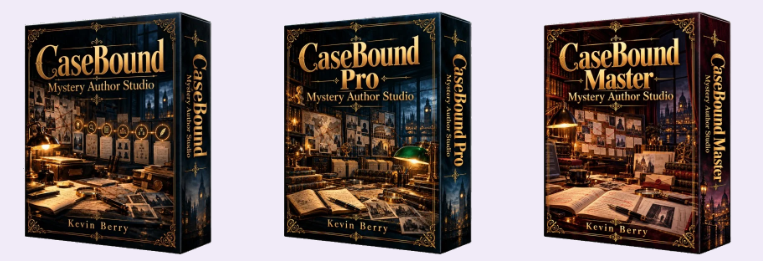
CaseBound Pricing: Which Edition Should You Buy?
Pricing is one of the most important considerations in this CaseBound review.
Unlike products that offer only a basic package followed by unclear upgrades, CaseBound currently advertises three editions.
CaseBound Author — $27
The Author edition is the entry-level package.
It includes the complete core mystery-writing engine.
You receive the case development workflow, Mystery Audit, story bible, chapter outlining, manuscript drafting process, and supporting tools.
It also includes two mystery subgenres and twelve historical research dossiers.
Best for: Beginners who want to write classic cozy or historical mysteries without spending much money.
CaseBound Pro Author — $97
The Pro edition includes everything in the Author package.
It expands the available mystery subgenres from two to ten.
It also includes forty historical dossiers, custom research capabilities, and additional writing-style controls.
Best for: Authors who want to write multiple mystery subgenres or develop a more distinctive writing voice.
CaseBound Master Author — $147
The Master edition includes everything in Pro.
It adds several post-draft tools, including:
- Fieldwork Line Edit.
- Fieldwork Continuity.
- Trim Reaper paperback formatting.
- Reader Reach promotion planning.
These tools are intended to help authors refine manuscripts and prepare them for publication.
Best for: Writers who expect to produce multiple books and want additional editing and production support.
CaseBound Pricing Comparison
| Feature | Author | Pro Author | Master Author |
|---|---|---|---|
| Price | $27 | $97 | $147 |
| Complete Writing Engine | Yes | Yes | Yes |
| Mystery Audit | Yes | Yes | Yes |
| Mystery Subgenres | 2 | 10 | 10 |
| Historical Dossiers | 12 | 40 | 40 |
| Custom Research | No | Yes | Yes |
| Advanced Style Controls | No | Yes | Yes |
| Line Editing Tools | No | No | Yes |
| Continuity Tools | No | No | Yes |
| Paperback Formatting | No | No | Yes |
| Promotion Planning | No | No | Yes |
| Money-Back Guarantee | 30 Days | 30 Days | 30 Days |
These are the advertised launch prices for October 20–25, 2026.
Which CaseBound Edition Offers the Best Value?
For most beginners, the $27 Author edition looks like the most sensible starting point.
It includes the core writing engine without requiring a larger investment.
The Pro edition becomes more attractive if you want access to additional mystery genres and advanced style controls.
The Master edition may be worthwhile for writers who specifically need its editing and paperback production tools.
However, paying more won’t automatically produce a better novel.
Your writing decisions, revisions, and editorial standards will still influence the final result.
Our recommendation: Start with Author unless you already know you need the expanded features.
Get CaseBound at the Current Launch Price
Does CaseBound Really Work? Examining the Published Results
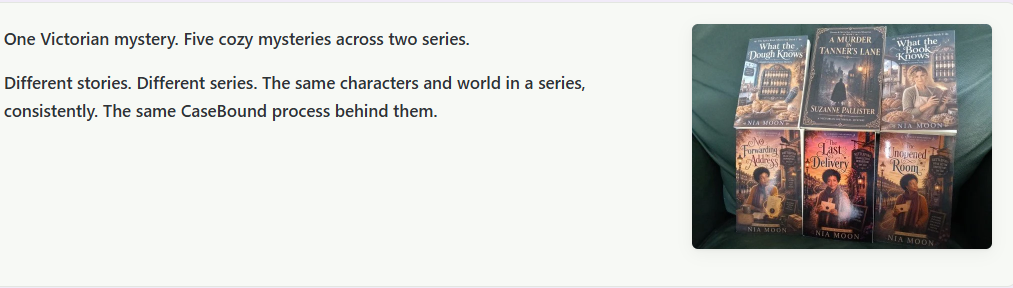
One of CaseBound’s more interesting selling points is that its creator provides examples of books developed using the system.
According to the official website, six selected mystery books created with CaseBound recorded:
| Reported Metric | Result |
|---|---|
| Published Books | 6 |
| Ebook and Paperback Sales | 144 |
| Kindle Pages Read | 7,310 |
| Estimated Royalties | $280.02 |
These figures relate to the specific books and reporting periods shown by the creator.
They are not independent performance benchmarks.
One featured title, A Murder in Tanner’s Lane, reportedly recorded 38 sales, 3,104 Kindle page reads, and $110.59 in estimated royalties during its displayed reporting period.
The creator also provides writing samples and links to published books.
This is more useful than relying entirely on generic promotional claims because prospective buyers can inspect examples of the output.
However, several limitations matter.
First, the published manuscripts received AI-assisted and manual editing.
Second, the reported results belong to the creator, who already has fiction-writing experience.
Third, publishing a book doesn’t guarantee sales.
Our assessment: The published examples provide evidence that the creator has used CaseBound to develop real books. They do not establish what a typical beginner will achieve.
Can You Make Money With CaseBound?
Potentially, but there is no guaranteed income.
CaseBound helps with the writing process.
It does not automatically create a profitable publishing business.
Authors may choose to publish their books through platforms such as Amazon Kindle Direct Publishing.
However, commercial success depends on several factors.
These include:
- Manuscript quality.
- Reader demand.
- Genre selection.
- Cover design.
- Book descriptions.
- Pricing.
- Reviews and reader satisfaction.
- Marketing and promotion.
A well-written mystery can still struggle to attract readers if its cover, positioning, or marketing is ineffective.
Likewise, producing several books quickly does not guarantee meaningful royalties.
CaseBound should therefore be evaluated primarily as a creative productivity tool.
If you are considering it solely because you expect passive income from AI-generated books, you may be disappointed.
CaseBound Pros and Cons
No writing tool is perfect.
Here are the most important advantages and limitations based on the available product information.
Pros
Structured mystery development
CaseBound offers a guided workflow rather than relying entirely on unstructured AI prompts.
Specialized plot auditing
The twelve-point Mystery Audit addresses problems that are particularly relevant to mystery fiction.
Affordable entry-level option
The $27 Author edition provides access to the complete core writing engine.
Multiple writing options
Higher editions support ten mystery subgenres and additional creative controls.
Published-book examples
The creator provides examples of completed books developed using the system.
One-time software pricing
CaseBound does not advertise its own recurring subscription or per-book credit charges.
Commercial publishing rights
According to the vendor, users may commercially publish the works they create.
Cons
Requires a separate Claude account
The purchase price does not include a Claude subscription.
Limited to mystery-focused writing
CaseBound is not designed as a universal writing platform for every fiction genre.
Editing is still necessary
Generated manuscripts require careful review and revision.
Higher editions cost significantly more
The $97 and $147 packages may be unnecessary for beginners.
No guaranteed book sales
Creating a manuscript does not automatically generate publishing revenue.
Independent performance remains unverified
We have not independently tested the software or measured its output quality across complete manuscripts.
CaseBound vs Claude: Why Not Just Use Claude Directly?
This is one of the most important questions prospective buyers should ask.
After all, CaseBound uses Claude as part of its writing process.
Why purchase an additional tool?
The main distinction is workflow.
Claude is a general-purpose AI assistant capable of helping users brainstorm plots, develop characters, and draft fiction.
However, users typically need to organize the writing process themselves.
That may involve maintaining character notes, tracking clues, checking timelines, and repeatedly supplying context.
CaseBound packages a mystery-specific process around those tasks.
CaseBound vs Claude Comparison
| Feature | CaseBound | Claude Alone |
|---|---|---|
| General AI Writing | Mystery-focused | Broad writing capabilities |
| Structured Mystery Workflow | Built in | User must organize |
| Mystery Audit | Dedicated process | Requires custom instructions |
| Story Bible | Integrated workflow | Can be created manually |
| Chapter Planning | Guided | Prompt-dependent |
| Creative Flexibility | Mystery-focused | Broader |
| Additional Software Purchase | Yes | No |
| AI Account Required | Claude | Claude |
The real question isn’t whether Claude can write mystery fiction.
It can assist with that task.
The question is whether CaseBound’s structured workflow saves enough time and effort to justify the additional purchase.
For experienced prompt writers, Claude alone may be sufficient.
For beginners who prefer a guided system, CaseBound could offer meaningful convenience.
Is CaseBound Suitable for Beginners?
CaseBound appears particularly relevant to beginners who have story ideas but limited experience planning full-length novels.
A common challenge for first-time authors is understanding how to move from an interesting premise to a complete manuscript.
The initial idea may be exciting, but developing believable suspects, meaningful clues, and a satisfying ending requires planning.
CaseBound attempts to simplify this process.
Instead of requiring writers to invent an entire workflow, it provides structured stages.
Beginners can focus on making creative decisions while the system helps organize the underlying story information.
However, beginners should understand that the tool does not eliminate the need to learn storytelling fundamentals.
Character development, pacing, dialogue, and narrative tension still matter.
The strongest results will likely come from writers who treat AI-generated material as a draft to improve rather than a finished product.
Can You Publish CaseBound Books on Amazon KDP?
According to the CaseBound vendor, users retain commercial publishing rights to the material they create.
That means the software is intended to support books that can be sold commercially.
However, publishing on Amazon KDP involves additional requirements.
Authors must follow the platform’s applicable content and AI disclosure policies.
They should also ensure that their manuscripts do not infringe third-party intellectual property rights.
Before publishing, review your manuscript for originality, consistency, formatting problems, and factual errors.
A sensible publishing workflow would involve completing the manuscript, performing developmental edits, proofreading, preparing a suitable cover, formatting the book, and reviewing the publishing platform’s current requirements.
CaseBound may assist with parts of this process.
It does not replace every stage.
Does CaseBound Have Hidden Monthly Fees?
CaseBound advertises one-time pricing for its three editions.
According to the vendor, the software itself does not require recurring subscription payments or per-book credits.
However, there is an important distinction.
CaseBound requires users to provide their own Claude account.
Claude’s usage limits apply independently of the CaseBound purchase.
Depending on your writing volume and account requirements, you may decide to purchase a paid Claude plan.
Therefore, the total cost of using CaseBound may be higher than the initial software price.
This is particularly relevant for authors planning to generate long manuscripts regularly.
Before buying, consider how much AI usage your intended writing schedule may require.
Who Should Buy CaseBound?
CaseBound may be a good fit for aspiring mystery authors who want a structured introduction to novel writing.
It may also appeal to experienced writers who want to streamline repetitive planning tasks.
Authors developing cozy mystery series could benefit from having an organized process for creating suspects, clues, timelines, and recurring story details.
Historical mystery writers may find the included research dossiers particularly interesting.
The higher editions may appeal to writers who want to experiment with police procedurals, legal mysteries, and other mystery subgenres.
Who Should Avoid CaseBound?
CaseBound may not be the right choice if you’re primarily interested in nonfiction, business books, or unrelated fiction genres.
It may also disappoint buyers who expect to generate polished, publication-ready novels without editing.
If you’re already comfortable managing a detailed writing workflow in Claude, you may not need an additional system.
And if your main objective is guaranteed passive income, CaseBound is unlikely to meet that expectation.
Its value lies in supporting the writing process, not guaranteeing financial outcomes.
CaseBound Bonuses and Refund Policy
During the advertised launch period, CaseBound includes two promotional bonuses.
The first is a market analysis focused on Scottish cozy mysteries set during the 1920s.
The second is a historical reference dossier covering Edinburgh in 1924.
The vendor assigns these bonuses a combined value of $64.
That figure represents the seller’s stated valuation, not an independently established market value.
Availability may change after the launch period.
CaseBound Money-Back Guarantee
The official website advertises a 30-day money-back guarantee.
According to the vendor, customers may request a refund within that period if the product does not meet their needs.
A refund also ends the customer’s licence to use the software.
Buyers should review the current refund terms before purchasing.
Check CaseBound Bonuses and 30-Day Guarantee
CaseBound Review: Frequently Asked Questions
Is CaseBound a legitimate AI writing tool?
CaseBound is a publicly advertised AI-assisted mystery writing product developed by Kevin Berry. Its website includes feature descriptions, published-book examples, pricing, and refund information. However, independent hands-on testing would be needed to verify the complete customer experience.
How much does CaseBound cost?
The advertised launch prices are $27 for Author, $97 for Pro Author, and $147 for Master Author. Prices may change after the promotional period.
Does CaseBound require Claude?
Yes. CaseBound uses Claude for AI-assisted writing, and users need their own Claude account.
Can CaseBound write a complete novel?
The system is designed to help users develop and draft a complete mystery manuscript. However, the resulting draft still requires review, editing, and publication preparation.
Is CaseBound suitable for beginners?
Yes, its guided workflow appears suitable for beginners who want assistance with mystery plotting and manuscript development. However, users still need to make creative decisions and edit their work.
Can I sell books created with CaseBound?
According to the vendor, users can commercially publish books created with the software. Authors must still comply with the policies of their chosen publishing platforms.
Does CaseBound work for nonfiction books?
CaseBound is primarily designed for mystery fiction. It is not positioned as a general-purpose nonfiction writing system.
Does CaseBound guarantee Amazon Kindle sales?
No. Book sales depend on reader demand, manuscript quality, marketing, pricing, and other factors.
Is CaseBound a monthly subscription?
The vendor advertises one-time software pricing. However, Claude is a separate service with its own usage limits and potential subscription costs.
What is the difference between CaseBound Author and Pro?
Author includes the complete core writing engine and two mystery subgenres. Pro adds eight more subgenres, additional historical research resources, and advanced writing-style controls.
Is CaseBound Master Author worth the extra money?
Master may be worthwhile for writers who need additional line-editing, continuity checking, paperback formatting, and promotional planning tools. Beginners may find the Author edition sufficient.
Does CaseBound offer a refund?
The vendor advertises a 30-day money-back guarantee, subject to its published terms.
Final Verdict: Is CaseBound Worth It in 2026?
CaseBound offers an interesting approach to AI-assisted fiction writing.
Rather than treating novel creation as a simple text-generation task, it focuses on the structure that makes mystery stories work.
Its case-first workflow, twelve-point Mystery Audit, story bible, and guided chapter development distinguish it from a basic collection of writing prompts.
The published examples presented by Kevin Berry also provide prospective buyers with material they can inspect before making a decision.
However, several limitations remain.
CaseBound requires a separate Claude account, generated manuscripts still need editing, and successful publishing depends on much more than the writing software.
There is also limited independent evidence about how consistently the system performs for beginners.
Our final assessment: CaseBound is worth considering if you specifically want to write mystery novels and prefer a structured AI-assisted workflow.
For most first-time buyers, the $27 Author edition appears to offer the best starting value.
Writers who need additional genres and research tools may prefer Pro, while Master is more appropriate for those seeking extra editing and production features.
Ultimately, the value of CaseBound depends on whether its workflow helps you create better, more consistent manuscripts than you could produce with your existing writing tools.
If mystery writing is a serious creative goal, CaseBound deserves a closer look.